Hornady 308 Win 168gr a Max Tap Precision Review
By Kip Staton
Hornady is well known for their zero-compromise attitude when it comes to bullet blueprint and construction. Does the same hold true when those same bullets are loaded into their Hornady Lucifer Ammunition line? Let's have a look. First, the details:
- Caliber: 308 Winchester
- G1 Ballistic Coefficient: .450
- Sectional Density: .253
- Claimed velocity from 24" barrel: 2700 FPS
- Detail Number: 8097
We'll go through the Hornady Friction match 308 Winchester ammunition component by component, and so take a look at groups at varying distances.
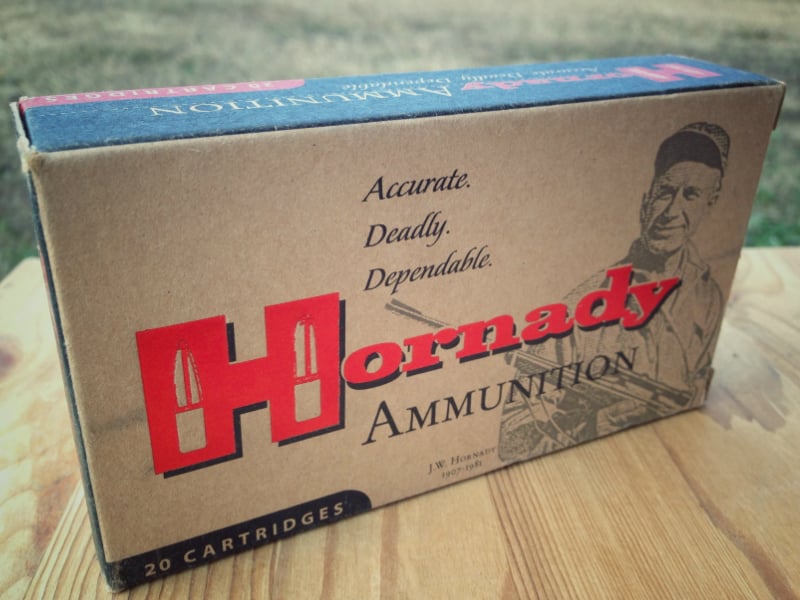
Hornady Lucifer Components
At that place really isn't much to say virtually primers. Just similar all Hornady products, the primers inserted into the Match line are some of the best bachelor. Each primer type is selected to complement the rest of the cartridge's composition. The primers are silver in color, and none of them failed to ignite a powder charge.
Like most commercial armament, the primers are not sealed or crimped in place.
The contumely cases on Hornady Friction match armament become a little scrap of extra attention at the establish. Each one is hand selected for product based on the following criteria:
- Wall thickness uniformity
- Internal capacity
- Case weight
- Consistent wall concentricity
These specific areas ensure that bullets are seated properly, and that chamber pressures are held to a consistent standard for the best velocity window and repeatable precision. To check the veracity of these claims, I weighed out 100 one time-fired cases to see how they compared:
- 44% weighed between 162.0 and 162.9 grains
- 29% weighed between 163.0 and 163.9 grains
- 7% weighed between 165.0 and 165.ix grains
- seven% weighed between 164.0 and 164.ix grains
- 4% weighed betwixt 160.0 and 160.9 grains
- 6% weighed between 161.0 and 161.9 grains
- 3% weighed betwixt 166.0 and 166.9 grains
Brass featured a minimum weight of 160.ii grains, and a max weight of 166.6 grains. Every bit we can see above, a big per centum weighed within 1 grain, plus or minus.
If we assume that the outside of the brass casings are all identical and made to the right spec (and outer dimensions should be very close afterwards firing through the aforementioned sleeping accommodation), and so any case weight variations stem from internal dimension discrepancies. These internal variations tin can lead to different pressures (and velocities) when firing, so it's best that they are kept to a minimum.
The powders in Hornady match armament are all caliber-matched to each load for best possible burn rate, pressure curves, and consistency of velocity.
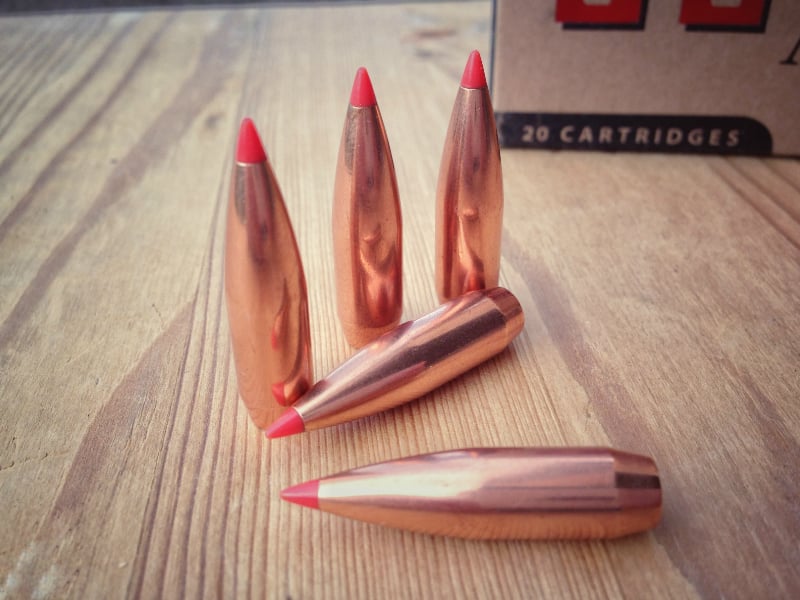
This particular load featured the first-class 168 grain AMAX bullet, with the AMP jacket. These jackets were designed to provide "near-zero wall thickness variation." This provides an exceptionally concentric and uniform bullet jacket.
An like shooting fish in a barrel-to-replicate polymer tip continues this theme of consistency. It'south much easier to produce a uniform polymer tip than one formed from the jacket. A boat-tailed design provides further ballistic efficiency, culminating in a G1 BC of .450.
Hornady Match 308 Winchester Velocities
Running 10 of the 168 grain AMAX loads over a chronograph in 68 caste weather provided these results:
- 2574
- 2554
- 2569
- 2574
- 2544
- 2550
- 2555
- 2495
- 2508
- 2550
This works out to an average speed of 2547 feet per second out of the xviii" barrel on my Ruger American Predator rifle. The mill information indicates that the load should clock in at 2700 FPS from a 24" barrel, and so real-world operation loses about 20 FPS per inch with this detail load out of my barrel. Pretty normal.
The Hornady Friction match 308 Winchester gave me a velocity standard difference readout of 26. To requite you something to compare this to, elite handloaders endeavour to achieve a SD in the single digit range. The Hornady ammunition hovers above that marking, which is to be expected.
Just to requite you a non-match comparing, ZQI M80 ball gives me SD of 42, taken over 10 shots from the same rifle.
Hornady Match Accurateness at Varying Distances
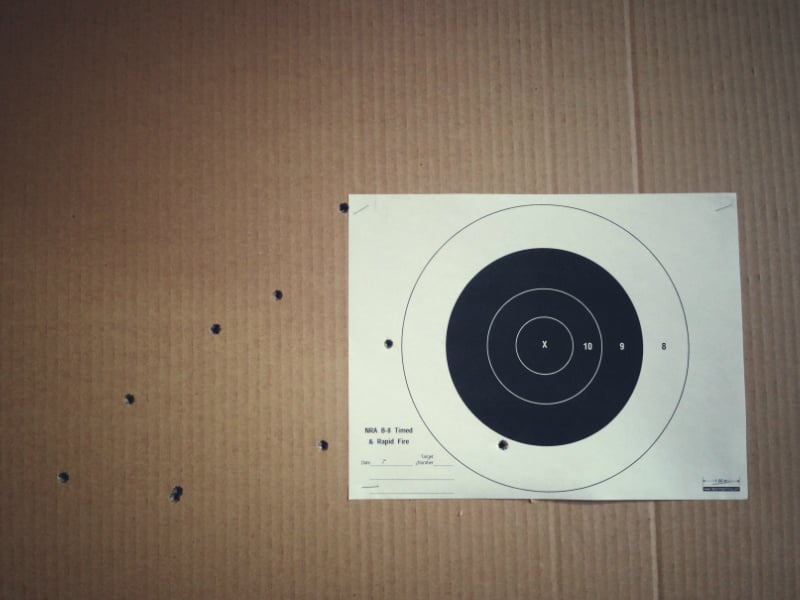
Of grade, all of this is merely academic if the ammunition won't shoot well. To check the accuracy (technically, the precision) of the Hornady 168 grain Match cartridges, I fired 2 ten shot groups: one at 100 yards and the other at 600 yards.
Conditions were favorable for both groups fired, but a bit on the chilly side weather-wise (45 degrees F). Both groups were fired from bipod-prone with a rear sandbag, using a SWFA SS 10×42 optic on a Ruger Predator burglarize.
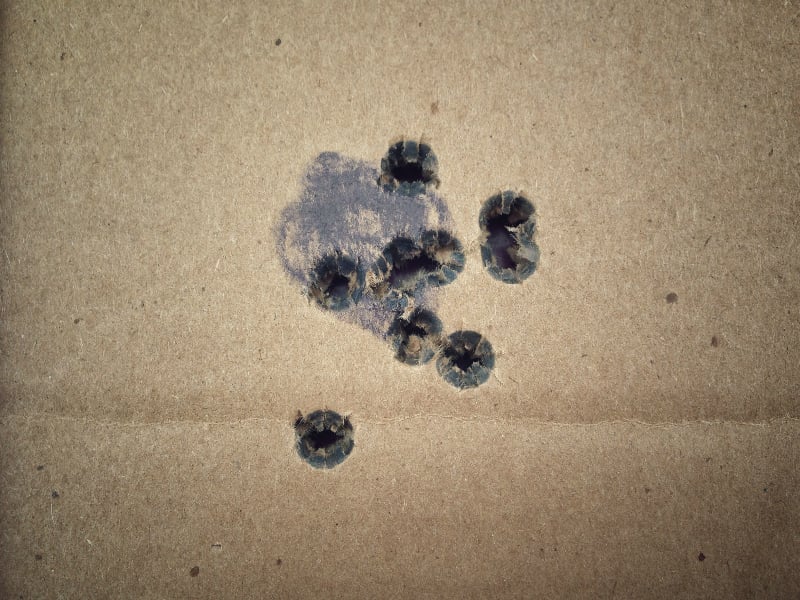
The x shot group at 100 yards measured 1 ⅜" on the vertical spread, and 1" even on the horizontal.
The next group was fired at 600 yards, on an NRA B8 replacement center. The black 9 ring on a B8 is 5.5" beyond, so it measures a piddling less than 1 MOA at 600 yards. The 600 g group had an viii" vertical spread, and a 12" horizontal. I wasn't doing anything to attempt and compensate for the very light cantankerous cakewalk, and it only moved the group ~half dozen" to the left.
Is Hornady Lucifer Ammo Worth It?
For many shooters, match-grade armament is associated with a lucifer-grade price. Functioning isn't costless. Whether yous buy or handload friction match ammunition, it's going to cost more than run-of-the-factory blasting ammo.
I reload most of my ammunition, with the goal of achieving a quality consequence while getting the cost per round down. Just how much tin can you really salve by duplicating the performance of good factory stuff (similar the Hornady Friction match) via handloading?
Using Hornady components and Varget powder, information technology would run you effectually $23.20 for a box of 20 reloads. By contrast, average sticker cost on a loaded box of Hornady 168 grain Match comes to $27.49.
That deviation quickly disappears once you factor in your time spent creating and testing match-level loads. Granted, the toll of handloads goes manner down when yous factor in reusing brass. But, starting from scratch, you aren't saving much past rolling your ain.
I'chiliad guessing (based on experience) that reloads would shoot a little ameliorate than the Hornady match ammunition, perhaps by a fraction of an inch or two. Is it worth the time spent at the loading bench? That'south upwards to you.
Performance by the Box
If y'all define "lucifer" every bit ammunition shooting near one MOA for 10 shots in real-world conditions, Hornady Match ammunition certainly lives up to its name. There'southward as well a great value here, for certain.
Choice up a couple of boxes, sight in your nearly precise rifle, and you lot'll exist set up for anything from a long range steel match to adjacent year's deer season.
rodriguezhantimpok.blogspot.com
Source: https://blog.gritrsports.com/hornady-match-ammunition-review/
0 Response to "Hornady 308 Win 168gr a Max Tap Precision Review"
Post a Comment