Art Is Visible However Everything One Sees Is Filtered

Famous Paintings Can Reveal Visual Disorders
Neural pathologies accept shaped great art throughout history
All visual art is illusory in that information technology involves a departure from reality, a filtering through the mind of the creative person. This subjectivity applies not just to abstract works simply also to representational fine art, in which the artist translates his or her perception into a physical object capable of inducing a similar perception in the viewer.
Painters render the 3-dimensional world on a apartment surface. These representations are enough to suspend our visual system's atheism and trigger barrages of neuronal firing that become visions of bathers, bridges and water lilies. It is never about reality but well-nigh how the artist sees and wants to portray it. This artistic vision is a mishmash of expectations, memories, assumptions, imagination and intent. It is as well, in a sense, a reflection of neural shortcuts and bones visual processes.
The picture becomes even more complicated when painters endure from pathologies of the eyes or brain that strength them to run across their surroundings in ways that diverge from standard experience. The artwork produced by such artists allows us to participate in their perception—and misperception—of the earth.
For example, declining vision can interpret into an eerie loss of precision and particular in paintings. The pictures of American artist Georgia O'Keeffe became flatter and less intricate as she developed bilateral age-related macular degeneration, a retinal disease that affects key, high-resolution vision. The afterwards works of American painter Mary Cassatt similarly prove an uncharacteristic absence of delicacy in faces as she developed cataracts. French impressionist Claude Monet also had cataracts, which rendered his paintings imprecise and muted in color. After he underwent successful cataract surgery, his paintings regained definition and vibrancy.
Equally the examples in this column adjure, the effects of vision or brain diseases can sometimes be traced in great works of art.

Francis Salary's Distortions
The works of 20th-century British painter Francis Bacon are notorious for their ability to unsettle viewers. The artist, once described by Margaret Thatcher as "that homo who paints those dreadful pictures," was upward-front end most his intent to provide a "visual daze" to audiences. Neuroscientists Semir Zeki and Tomohiro Ishizu, both at Academy College London, have argued that Bacon'south distorted faces and disfigured bodies—often reminiscent of violence and mutilation—are almost universally disturbing because of the way they subvert our encephalon'southward template for the human class. Several brain regions, such as the fusiform face area and the fusiform and extrastriate body areas, are specialized in the recognition of faces and bodies. Co-ordinate to Zeki and Ishizu, Bacon's paintings are just consistent plenty with the real human effigy that these parts of the brain are engaged. The troubling part for the viewer is that the details of Bacon's portraits are so distorted that they violate the brain's expectations for the body. This creates the viewer's sense of discomfort.
Avinoam B. Safran of the Academy of Geneva in Switzerland and his colleagues accept proposed that the painter suffered from a rare neurological disorder called dysmorphopsia, which produces progressively changing and distorted perceptions. In some sufferers, the illusory transformations and deformations primarily affect their perception of faces and bodies. Indeed, Bacon described his perception of faces equally ever changing, with the mouth and the head in abiding motion. According to Safran and his colleagues, the effects of Bacon'south perceptual deformations on his art were non unique: the drawings made by a patient with dysmorphopsia (acquired by a meningioma tumor) who also experienced aberrant perceptions of people bear a striking resemblance to Bacon's portraits.
Credit: CORBIS

Degas'southward Failing Vision
French artist Edgar Degas, who lived from 1834 to 1917, experienced progressive visual loss in the final 30 years of his life. In 2006 ophthalmologist Michael F. Marmor used data from Degas'southward correspondence and computational simulations of the painter'due south perception in an attempt to diagnose Degas and better understand how the creative person would have experienced the globe.
Marmor concluded that Degas's central vision, where vigil is sharpest, weakened in his later years. Many aspects of Degas'south art, such every bit the shading, colour and overall limerick of his paintings, were remarkably robust to his visual loss, still. Equally his central vision grew blurry, his paintings became coarser and lost refinement. Nevertheless Degas himself might not take noticed a fundamental departure between his earlier work and afterward paintings, such as this depiction of ballerinas from his later years. This is considering he would have been equally unable to focus his central vision on the older paintings. Marmor suspects that Degas'due south later works looked smoother and more natural to the painter (filtered through his own visual pathology) than to viewers with healthy eyes.
Credit: CORBIS

WAS EL GRECO ASTIGMATIC?
The 16th- and 17th-century paintings of El Greco are populated by famously elongated figures. These curious forms accept kindled speculation that the painter may have suffered from astigmatism, an optical defect. The reasoning goes that spectacle lenses could accept overcorrected El Greco's astigmatism, producing retinal images that were stretched horizontally, thus causing the master to paint tall and skinny objects that appeared normal to him.
To test this idea, vision scientist Stuart Anstis of the University of California, San Diego, transformed experimental subjects with normal eyes into "bogus El Grecos" with a special telescope that stretched their retinal images horizontally by thirty per centum. When the subjects attempted to draw a foursquare from memory, they drew a alpine, thin rectangle instead. Merely when they tried to copy an actual square, they drew a flawless replica. That is, there was an "El Greco" effect in the drawings made from memory but not in the copies. Then, to simulate lifelong astigmatism, Anstis persuaded a volunteer to clothing the distorting telescope for two days straight. She copied squares and drew squares from retention four times each day. The copied squares were always picture-perfect, merely the squares from memory were not always so: they started 50 percentage besides tall and grew progressively shorter with time. By the end of the second day, she was drawing impeccable squares. Anstis concluded that even if El Greco suffered from astigmatism, he would accept quickly adapted to it.
So why would El Greco employ such foreign figures? Creative evidence offers a unlike explanation. El Greco sketched his subjects with standard proportions first and only elongated them in his paintings. And he did so selectively, portraying angels as taller and svelter than people. The fact that El Greco did not ever apply an elongated fashion suggests that the lengthening was an aesthetic choice.
Credit: GETTY IMAGES

REMBRANDT'South STEREO Incomprehension
Shut your left and right eye in quick succession, and you will notice that each eye has a slightly different perspective. Neurons in the visual cortex of the encephalon utilise the horizontal shift between the ii eyes to produce stereoscopic vision, one of the principal ways in which nosotros are able to meet depth in the earth. Because our ii retinas are fundamentally two-dimensional structures, our perception of the tertiary dimension is an illusion, a brain construct.
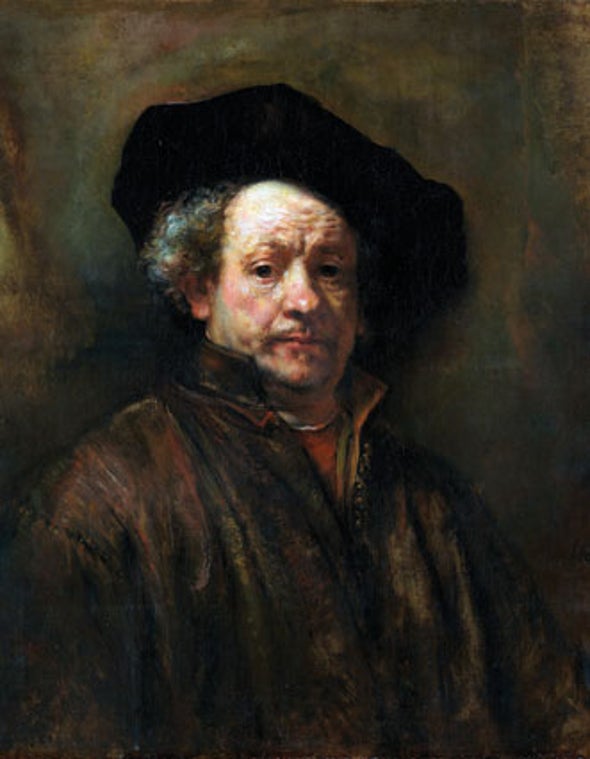
In 2004 neuroscientists Margaret Southward. Livingstone and Bevil R. Conway, both then at Harvard Medical School, observed that 17th-century Dutch painter Rembrandt van Rijn'due south eyes were often misaligned in his self-portraits, and so that one eye appeared to wait directly at the viewer, whereas the other eye looked off to the side. Livingstone and Conway wondered whether Rembrandt had painted himself with ruthless accuracy, which would advise that the painter was actually walleyed. They measured aspects of Rembrandt'south gaze in 36 self-portraits and found that if these paintings were truthful to life, Rembrandt did non accept normal stereovision. In curt, he would have struggled to see depth with stereoscopic cues.
Rembrandt's poor stereovision may take been advantageous. Art students routinely learn to shut one heart to replicate the three-dimensional world onto a flat medium with greater accuracy. Stereo incomprehension, or the inability to employ the horizontal shift between our eyes to encounter in 3-D, can therefore assistance artists in rendering the globe in two dimensions.
Livingstone and Conway went on to show that art students have poorer stereovision than students non majoring in arts and that the eyes of established artists take a more than pronounced misalignment than the eyes of nonartists. Stereo incomprehension may non brand y'all an artist—many established artists take normal stereovision, and most stereo bullheaded people are not artists—but the early sketches of stereo blind artists may be more accurate than those of people with normal stereovision. Thus, people with poor stereovision may feel more encouraged to persevere in their artistic training.
Credit: CORBIS

SELF-PORTRAITS OF A CRUMBLING Heed
American artist William Utermohlen received a diagnosis of likely Alzheimer's disease in 1995, at the age of 61. For the side by side five years, as his dementia worsened, he used his art to track the disintegration of his mind. Utermohlen's self-portraits, such as the sketches in a higher place from 1996, offer a window into the artist'southward experience of the progression of Alzheimer'southward. Many of the stylistic changes in the depictions are likely the event of the quick reject of Utermohlen'due south visuospatial and motor skills over the course of a few short years. Yet the portraits are also heartbreaking in that they expose a heed trying against hope to sympathise itself despite deterioration.
Credit: AP PHOTO
This article was originally published with the title "Warped Perceptions" in SA Mind 26, ii, 23-25 (March 2015)
doi:10.1038/scientificamericanmind0315-23
Further Reading
Some Workmen Can Arraign Their Tools: Artistic Change in an Private with Alzheimer's Illness. Sebastian J. Crutch et al. inLancet, Vol. 357, pages 2129–2133; June xxx, 2001.
Was Rembrandt Stereoblind? Margaret Due south. Livingstone et al. inNew England Journal of Medicine, Vol. 351, No. 12, pages 1264–1265; September sixteen, 2004.
Ophthalmology and Fine art: Simulation of Monet'due south Cataracts and Degas' Retinal Illness. Michael F. Marmor inJAMA Ophthalmology, Vol. 124, No. 12, pages 1764–1769; Dec 2006.
A Neurological Disorder Presumably Underlies Painter Francis Bacon Distorted World Delineation. Avinoam B. Safran et al. inFrontiers in Human being Neuroscience, Vol. 8, Article No. 581; August 29, 2014.
ABOUT THE Writer(S)


0 Response to "Art Is Visible However Everything One Sees Is Filtered"
Post a Comment